Peak shaving for industrial applications
Reduce peak demand with peak shaving. Lower electricity costs sustainably.
Short-term peak demand can lead to high demand charges and grid fees, significantly increasing annual electricity costs. Peak shaving with battery storage systems enables reliable reduction of demand peaks and helps lower long-term energy costs.
When peak demand becomes a cost issue
In many companies, short periods of high peak demand account for a large share of electricity costs. Even brief demand spikes can result in significant charges, regardless of overall energy consumption.
This becomes particularly critical when existing grid connections are already close to capacity or when expansions involve high costs and long lead times.
The key question is:
How can peak shaving reduce peak demand without limiting operations or future growth?
High demand charges
Short periods of peak demand can significantly increase annual electricity costs.

Rising grid fees
Grid fees are largely based on the highest recorded peak demand.

Limited grid connection capacity
Additional grid capacity is often expensive or technically difficult to implement.

Uncertain business case
Without precise system design, it remains unclear whether a battery storage system is economically viable.
Reduce peak demand with battery storage
Battery storage systems enable targeted peak shaving by reducing peak demand when it matters most. Energy is stored during periods of low demand and released precisely when short-term high demand occurs. This lowers maximum demand, demand charges, and grid fees over the long term.
INTILION approaches peak shaving as part of an integrated system, combining load profile analysis, grid connection, battery storage, control systems, and future applications. Each solution is designed on a project-specific basis, aligned with real load profiles and your company’s economic objectives.
- Reliable reduction of peak demand
- Measurable savings in demand charges and grid fees
- Automated and operationally stable system performance
- Scalable for growing demand, PV, or e-mobility

Why companies rely on INTILION for peak shaving
Peak shaving requires a specific demand analysis; the decisive factor is a design that precisely matches the load profile, the technical infrastructure and the economic framework conditions.
INTILION has extensive experience with industrial load profiles and develops systemic solutions instead of blanket storage sizes. Hardware, control and operation are coordinated with a clear focus on demonstrable cost-effectiveness and long-term operational reliability.
The solutions have a modular structure and can be flexibly expanded if requirements change, for example by integrating additional applications such as photovoltaics or charging infrastructure.
Further information:
BESS for industry
Example from practice:
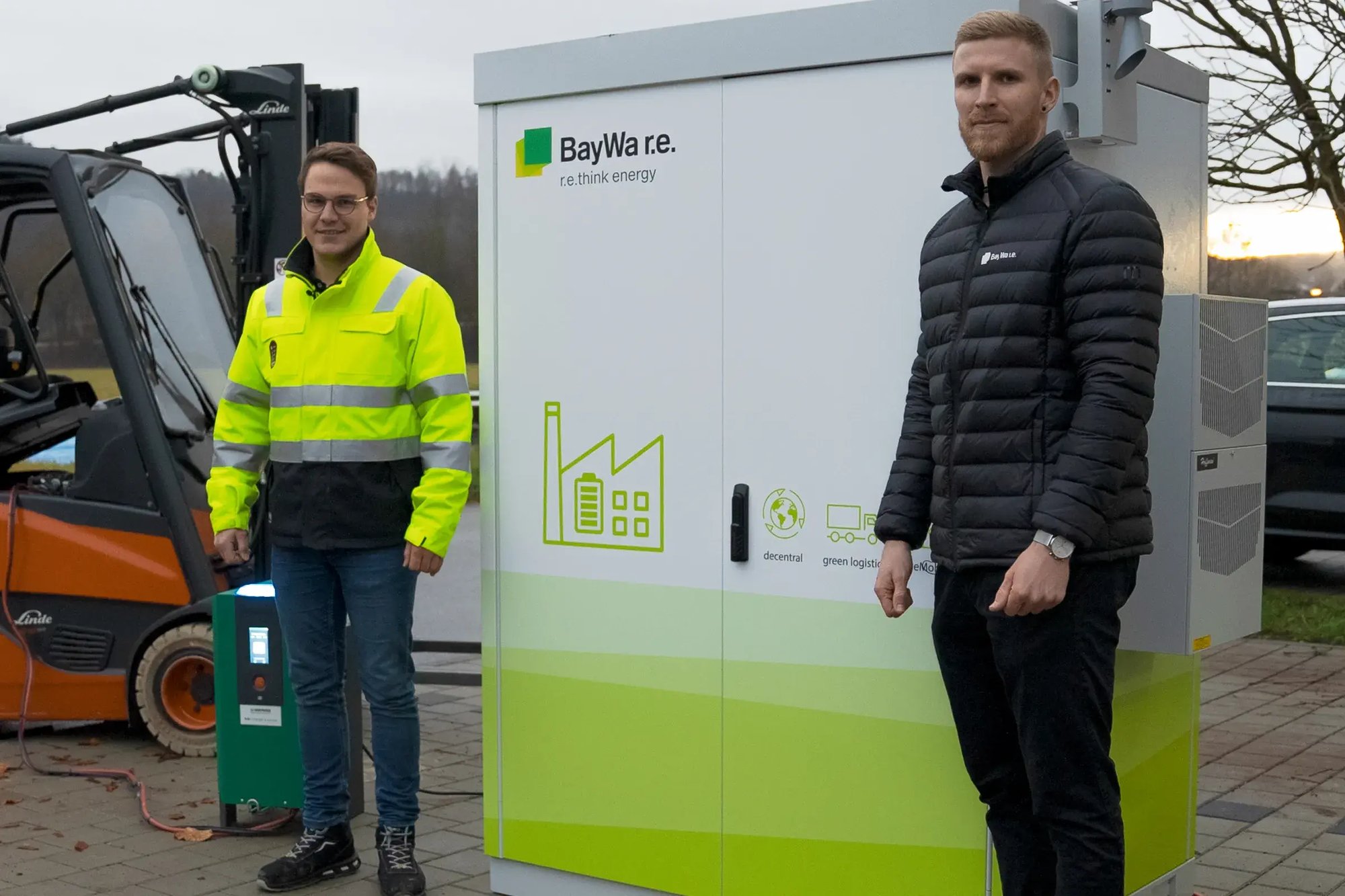
Peak Shaving in real use: BayWa r.e. Tübingen site
The following example shows how peak shaving can be implemented in practice. The project illustrates the basic functionality and the economic effect of peak shaving, regardless of the system configuration currently in use.
Green outlook for and with BayWa r.e.
Initial situation: At the warehouse location, short-term power peaks from industrial trucks and charging infrastructure led to high power prices, although the total energy consumption was moderate.
Challenge: Reduction of peak loads without restricting ongoing operations and without cost-intensive grid connection extensions.
Approach: Use of an electricity storage system that temporarily stores energy and provides it in a targeted manner to cap power peaks.
Result: Significant reduction in power prices and improved overall efficiency through the use of photovoltaic power. The solution could be flexibly integrated and expanded.
Is peak shaving worthwhile for your company?
If you are faced with high power prices or rising grid charges, we will check together whether peak shaving makes economic sense for your location.
As part of a profitability check, you will receive an initial assessment of your savings potential, a rough dimensioning of the electricity storage system and an estimate of the investment, operating costs and amortization.